American Army Groups
World War ZAmerican Army Groups—North, Center, and South—were the principal formations of the American continental offensive, the instrument through which the rebuilt United States Army slowly reclaimed territory from the living dead. Their decisive importance lay less in spectacular maneuver than in organizational learning: after the disaster at Yonkers exposed the weakness of conventional doctrine, the Army Groups turned warfare into a patient system of logistics, controlled fire, specialized reconnaissance, and methodical terrain clearance.
Structure and Strategic Mission
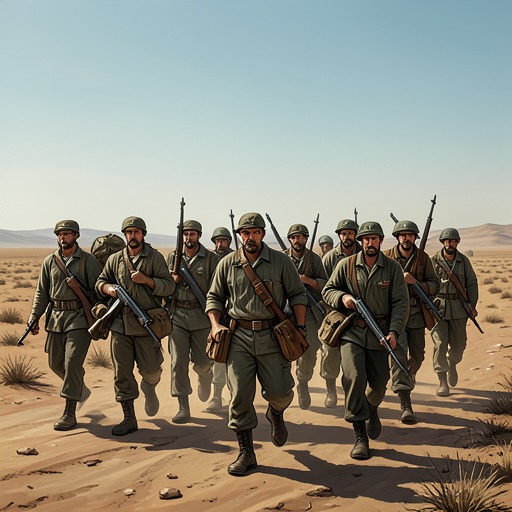
The three Army Groups advanced together along the so-called road to New York. Their grand strategy was to move across the Great Plains and Midwest as a unified front, then divide at the Appalachians. The northern and southern wings would sweep toward Maine and Florida before grinding across the coast to link up with Army Group Center, which would cross the mountains. The operation took three years, a duration that reflected the scale of the task rather than simple indecision.
The Army Groups were not advancing into a conventional theater with a retreating opponent. They confronted roughly two hundred million zombies spread across the continental United States, an enemy whose origin, physiology, strengths, weaknesses, motives, and mentality had been studied but could not be fitted into the inherited assumptions of military history. Armies were traditionally required to be bred, fed, and led; the living dead required none of those conditions. American planners therefore had to create a new military grammar rather than apply a familiar one to an unfamiliar enemy.
Doctrine After Yonkers
The Army Groups’ doctrine grew from the recognition that the living dead could not be defeated through psychological collapse. At Yonkers, soldiers had prepared ground-level positions behind sandbags and in fighting holes while leaving rooftops and commanding windows unused. The arrangement reflected Cold War expectations of artillery, aircraft, and small-arms threats, even though the enemy’s purpose was to advance directly into the defenders’ fire. The result was a defensive system that consumed energy while failing to exploit the terrain or the nature of the attack.
The disaster demonstrated that fear, an ancient weapon of war, could not work against an enemy biologically incapable of being shocked or awed. The living dead did not retreat when casualties mounted, and their absence of fear turned the human reliance on morale-breaking into a weapon against the defenders themselves. The Army Groups’ later methods therefore emphasized reliable procedures over intimidation, emotional momentum, or assumptions about enemy self-preservation.
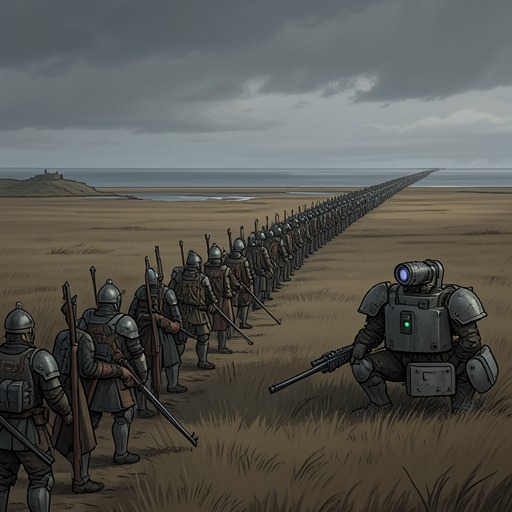
Their continental advance used two solid lines stretching from Canada to Mexico, with one line behind the other. The formation moved slowly enough to inspect every portion of ground between the Rockies and the Atlantic. The method was compared to a line of investigators searching a crash site for every fragment: no inch was deliberately skipped. This deliberate density reduced the danger of leaving isolated dead behind the advancing front, though it made the operation exceptionally slow.
Force Appropriate Response and Clearing Operations
The central tactical principle was Force Appropriate Response, or FAR. The Army Groups did not halt an entire formation for a single zombie or a small cluster. Instead, the appropriate local unit—a section, platoon, or company, depending on the size of the encounter—stopped to destroy and sanitize the threat. The gap left by that unit was filled by an equal force from the secondary line roughly a mile behind, preserving the continuity of the front while the forward element dealt with the immediate danger.
This leapfrogging system allowed the Army Groups to maintain pressure without wasting the movement and ammunition of the whole force. It also recognized that the most dangerous targets were not always the largest groups. Older zombies, weakened by years of decay, might be unable to stand but could crawl through mud or thrash facedown toward the line. Their physical deterioration made them easy to overlook and potentially more difficult to detect, so repeated inspection and battlefield sanitation remained essential.
The campaign’s difficulties varied by region. In the northern theater, winter froze or disabled many zombies, but it created a different threat for the soldiers. Temperatures fell substantially, and gray snow covered the ground. Every zombie destroyed before winter could represent another threat at the first thaw, when previously immobilized bodies became active again. Northern units therefore swept the same areas at least three times, using methods ranging from ramrods and trained detection dogs to ground radar. Frostbite caused more American casualties than the zombies themselves in some operations, while spring repeatedly threatened to reopen supposedly cleared territory.
After the fight around the Sears Tower in Chicago, the Army Groups also had to account for human enemies and other threats. A fortified group occupying the tower used high-powered rifles and refused to surrender its local kingdom, forcing the Americans to employ machine guns, grenades, and Bradley fighting vehicles. The encounter convinced commanders that the war had become a full, multithreat environment. Hard cover and body armor returned even during summer, and soldiers received a threat hierarchy ranked by probability rather than lethality: zombies formed the baseline, followed by large predatory creatures, feral survivors, quislings, and the most dangerous human opponents.
Weapons, Logistics, and Organizational Learning
The Army Groups depended on an industrial and logistical reconstruction that treated resources as part of combat power. During the Second World War, the Allies had prevailed through manufacturing capacity, raw materials, and the ability to move both inputs and finished materiel. In the new war, the living dead controlled most of the world’s landmass, while American production depended largely on what could be harvested in the western states. Refugees filled merchant ships, fuel shortages immobilized much of the navy, and overseas resources could no longer be assumed.
This scarcity encouraged the resource-to-kill ratio associated with General Travis D’Ambrosia. Weapons were judged not merely by technical sophistication but by the number of threats they could eliminate for the resources consumed. The principle shaped procurement and spread through the ranks, where soldiers began comparing alternative weapons in terms of cost and effectiveness. It also encouraged improvisation, especially among marines, whose dependence on naval procurement had made adaptation a long-standing necessity.
The Standard Infantry Rifle became the Army Groups’ principal weapon. Its wood furniture gave it the appearance of a Second World War firearm, but its practical virtues were modern and severe: it fired semiautomatically, remained accurate, and resisted jamming after exposure to mud, sand, and saltwater. A conversion kit allowed the same weapon to serve as a long-range rifle, midrange rifle, or close-combat carbine, while a roughly eight-inch folding spike offered an emergency alternative when the Lobotomizer was unavailable.
Its ammunition, NATO 5.56 Cherry PIE, was designed specifically for the undead target. The pyrotechnically initiated explosive round shattered inside a zombie’s skull and burned the brain without spreading infected gray matter. This eliminated the need for wasteful burning and simplified burial procedures: on battlefield sanitation duty, soldiers could place the entire body in a trench rather than decapitate it first. The weapon and ammunition together expressed the broader transformation from high-cost technological spectacle to dependable, repeatable, mass-deployable killing capacity.
The same logic governed the Continental Airlift, which supplied isolated American territories while the Army Groups advanced. It was described as the largest undertaking in air force history in statistical terms, requiring constant contact with scattered enclaves, processing their demands, coordinating with the Department of Strategic Resources, and prioritizing every delivery. Planners favored self-sustaining drops—tools, spare parts, and equipment for making further spare parts—over dependency drops of food and medicine, although autumn deliveries still included fish, wheat, salt, dried vegetables, and baby formula. Specialists such as doctors, engineers, and Special Forces instructors were also parachuted into zones that often lacked airstrips and offered no prospect of extraction.
Training, Dogs, and the Human Front
The Army Groups fought with personnel drawn from a society that had already been transformed by the crisis. Physical stamina, mental competence, motivation, and discipline remained necessary, but soldiers also had to endure long-term Z-shock. Some experienced troops collapsed under the strain, turned weapons on themselves, or attacked comrades. The new army was therefore not simply a professional force expanded for wartime; it was a force composed of people who had already survived the catastrophe in civilian life, including figures as varied as former insurance salesmen and Sister Montoya, a fifty-two-year-old nun who had protected her Sunday-school class for nine days with a six-foot iron candlestick before joining the march from Needles to the contact site outside Hope, New Mexico.
Military working dogs supplied another crucial adaptation. Dogs were first used in triage, sniffing out infection through methods modeled on Israeli practice, in which people passed cages containing the animals. The animals had to remain caged because some reacted with uncontrollable violence toward subjects, other dogs, or their handlers; many handlers lost hands, arms, or throats. Yet the same terror instinct that made the dogs dangerous also allowed them to detect infection and save lives.
The American program attempted to incorporate that instinct into regular training rather than merely exploit it. Puppies were tested young in rooms divided by wire mesh, with the living dead placed on the opposite side. Some animals whimpered or howled and were classified as failures, while others held eye contact, bared their teeth, and stood their ground. Purebred dogs proved unsuitable because selective breeding had produced health and temperament problems, so the newer generation favored mixed ancestry and a balance of physical constitution and mental stability.
Trained dogs became especially important on long-range patrol missions over wild terrain, where teams faced not only the living dead but feral packs descended from abandoned pets and strays. Early patrols were frequently aborted before escort dogs were deployed. Escort animals could turn a mission from a movement through a hostile landscape into a viable operation: Pongo, a pit bull and Rottweiler mix, and Perdy, an unusually large mixed dog, repeatedly drove off feral packs, including one encounter in which Perdy crushed the skull of a two-hundred-pound mastiff.
Historical Significance
American Army Groups represent the institutional answer to a war that invalidated the assumptions of modern military power. Their campaign rejected the promise that superior technology alone could produce victory, just as it rejected the belief that a battlefield could be secured through morale effects or a single decisive blow. Instead, victory emerged from the accumulation of small certainties: a continuous line, an appropriate local response, a rifle that did not jam, ammunition that did not require a bonfire, dogs trained to recognize the dead, repeated sweeps, and an airlift designed to provide tools rather than indefinite dependence.
Their three-year march was slow because it was intentionally comprehensive. The Army Groups advanced as a machine for refusing gaps—to leave no inch of territory unchecked, no isolated zombie unaccounted for, no vulnerable community entirely beyond the reach of supply, and no lesson from earlier failure unused. In that sense, their achievement was organizational before it was territorial: they converted a shattered defensive army into a patient continental system capable of reclaiming a world that could not be frightened back into submission.